
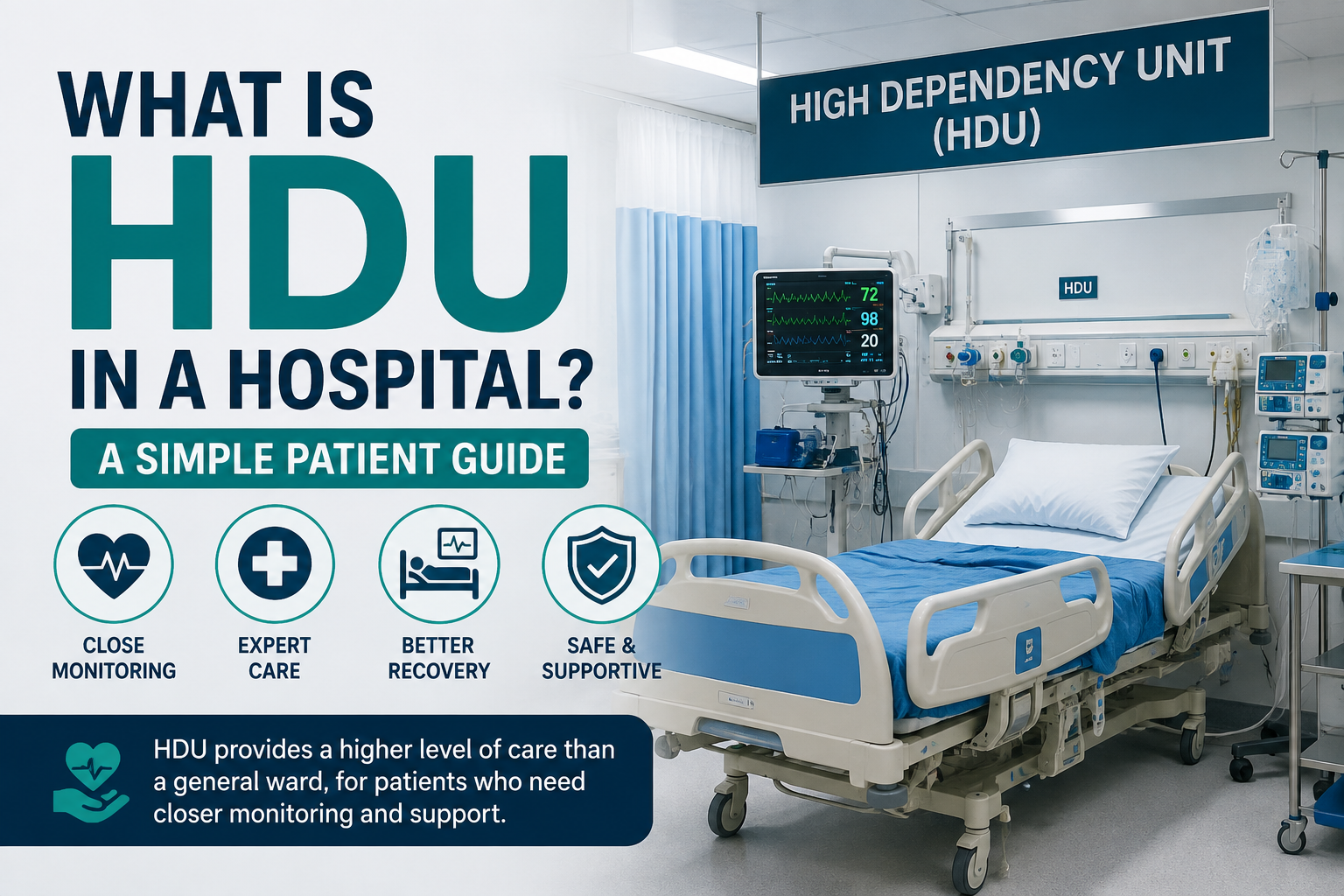
Hospital terms can be confusing, especially when a family member suddenly needs a higher level of care. ICU, CCU, and HDU may sound similar, but they are not always the same.
HDU stands for High Dependency Unit. It is a specialized hospital area for patients who need closer monitoring and more medical support than can usually be provided on a general ward, but who may not require full intensive care. Patients and families in Karachi can also learn more about different levels of hospital care through The Modern Hospital.
What Does HDU Stand For in a Hospital?
HDU stands for High Dependency Unit.
It is sometimes considered an intermediate level of care between a general hospital ward and an Intensive Care Unit, or ICU.
Patients in an HDU usually require:
- More frequent observations
- Closer nursing supervision
- Continuous or frequent monitoring
- Additional oxygen or breathing support in some cases
- More complex medicines or treatments
- Faster medical response if their condition changes
The exact type of care provided can differ between hospitals.
Why Is an HDU Needed?
Some patients are too unwell for routine ward care but do not need the full level of organ support available in intensive care.
An HDU helps bridge this gap.
For example, a patient may have undergone major surgery and need close observation for possible complications.
Another patient may be recovering from a serious illness and no longer require ICU care but still need more monitoring than a regular ward can provide.
This allows healthcare teams to match the level of care to the patient's condition.
Who May Be Admitted to an HDU?
There is no single condition that automatically leads to HDU admission.
A healthcare team may recommend HDU care for patients who:
- Have undergone major or complicated surgery
- Need close post-operative monitoring
- Have a serious infection
- Need additional breathing support
- Have an unstable medical condition
- Are deteriorating on a general ward
- Are recovering after intensive care
- Need frequent observations or medication adjustments
Admission decisions depend on the patient's individual medical condition.
What Happens in a High Dependency Unit?
Patients in an HDU are monitored more closely than those on a standard hospital ward.
Healthcare professionals may regularly or continuously monitor:
- Heart rate
- Heart rhythm
- Blood pressure
- Oxygen saturation
- Breathing rate
- Temperature
- Fluid balance
- Urine output
The patient's condition determines which measurements are most important.
Medical teams can respond quickly if these observations show concerning changes.
What Equipment May Be Used in an HDU?
An HDU often contains more monitoring equipment than a general ward.
Patients may see:
- ECG or cardiac monitors
- Blood pressure monitors
- Oxygen monitors
- Intravenous pumps
- Oxygen delivery equipment
- Breathing-support devices
- Urinary catheters
- Other specialist equipment
Not every patient requires every type of device.
The healthcare team chooses equipment according to the patient's individual needs.
HDU vs ICU: What Is the Difference?
One of the most common questions is whether an HDU is the same as an ICU.
Usually, it is not.
HDU
A High Dependency Unit provides a higher level of care than a normal ward.
Patients may need close monitoring or support for one important body function, but they may not require the full level of intensive care.
ICU
An Intensive Care Unit generally cares for patients who are more critically ill.
ICU patients may require:
- Mechanical ventilation
- Advanced cardiovascular support
- Multiple organ support
- Continuous intensive monitoring
- A higher nurse-to-patient ratio
The exact distinction differs by healthcare system and hospital.
A patient may move from ICU to HDU as their condition improves.
Likewise, an HDU patient whose condition becomes more serious may need transfer to an ICU.
HDU vs General Ward
The difference between an HDU and a normal ward is mainly the intensity of monitoring and care.
On a general hospital ward, patients are usually medically stable enough that they do not require constant monitoring.
An HDU may provide:
- More frequent vital-sign checks
- Higher nursing attention
- Continuous monitoring when needed
- Faster intervention if the patient's condition changes
- More advanced medical equipment
This does not mean every person in an HDU is critically ill.
It means their medical needs require closer observation.
Is HDU the Same as CCU?
Not necessarily.
HDU means High Dependency Unit.
CCU most commonly means Coronary Care Unit or Cardiac Care Unit.
A CCU focuses mainly on patients with serious heart-related problems.
An HDU can care for patients with many different medical or surgical conditions.
However, terminology varies between hospitals, so families should always ask what an abbreviation means in the specific hospital they are visiting.
Why Might Someone Move From ICU to HDU?
Moving from intensive care to an HDU can be part of the recovery process.
A patient may no longer need the full level of support provided by ICU but may still require:
- Close monitoring
- Oxygen support
- Frequent nursing care
- Ongoing treatment
- Observation for complications
The HDU can provide a safer transition before the patient moves to a general ward.
This transition is sometimes called step-down care.
Can a Patient Move From HDU to ICU?
Yes.
If a patient's condition deteriorates and they require more intensive support, the healthcare team may transfer them to an ICU.
Possible reasons include:
- Worsening breathing problems
- Severe infection
- Unstable blood pressure
- Organ failure
- Other rapid changes in condition
The decision depends on the patient's individual needs.
How Many Nurses Care for HDU Patients?
High Dependency Units usually have a higher nurse-to-patient ratio than general wards.
For example, some NHS HDUs describe approximately one nurse for every two patients, although staffing arrangements vary by hospital and healthcare system.
This higher level of nursing attention allows patients to be observed more closely.
How Long Does Someone Stay in an HDU?
There is no standard length of stay.
A patient may stay for:
- Several hours
- One night
- A few days
- Longer, depending on their condition
The healthcare team regularly reviews whether the patient still needs high-dependency care.
When the patient's condition becomes stable enough, they may move to a general ward.
Can Family Members Visit an HDU?
Most hospitals allow some family visits, but HDUs may have stricter rules than normal wards.
This is because:
- Patients need rest
- Medical procedures may be taking place
- Infection prevention is important
- Staff need space around specialist equipment
Visitors may be asked to:
- Wash or sanitize their hands
- Follow visiting hours
- Limit the number of people visiting
- Avoid visiting when unwell
- Follow instructions from healthcare staff
Always check the hospital's individual visiting policy.
What Questions Can Families Ask the Medical Team?
A family member's admission to an HDU can feel stressful.
Useful questions include:
- Why does the patient need HDU care?
- What is being monitored?
- Is the patient's condition stable?
- What treatment is currently being provided?
- What changes are the team watching for?
- Could ICU care become necessary?
- When might the patient move to a normal ward?
Clear communication can help families better understand the patient's situation.
Why Clear Hospital Information Matters
Hospital abbreviations can cause unnecessary confusion, especially during stressful situations.
However, online information should only provide general education.
It cannot tell you what level of care an individual patient personally needs.
That decision must be made by the treating healthcare team.
HDU and Hospital Care in Karachi
Different hospitals organize critical and high-dependency care in different ways.
The Modern Hospital in Gulshan-e-Iqbal, Karachi, lists inpatient care, emergency care, and NICU-ICU services among its hospital services.
Its public website does not clearly list a dedicated HDU service, so patients who specifically require High Dependency Unit care should confirm availability directly with the hospital rather than assuming that the service is provided.
Frequently Asked Questions
What is the full form of HDU in a hospital?
HDU stands for High Dependency Unit.
It provides closer monitoring and a higher level of care than a general hospital ward.
Is HDU serious?
Admission to an HDU means a patient requires closer medical monitoring or support.
The seriousness of the condition varies from patient to patient.
Is HDU worse than ICU?
It is better to think in terms of levels of care rather than "better" or "worse."
ICU usually provides a higher level of intensive support, while HDU is often used for patients who need more care than a general ward but less than full intensive care.
Can an HDU patient talk and eat normally?
Some can, while others may be too unwell or require specific medical support.
It depends entirely on the patient's condition and treatment.
Does an HDU patient need a ventilator?
Not usually in the same way as a critically ill ICU patient, although some HDUs can provide certain types of breathing support.
The facilities available vary between hospitals.
Can you recover and leave an HDU?
Yes.
When the patient's condition improves and high-dependency monitoring is no longer required, they may be transferred to a general hospital ward.
Final Thoughts
So, what is HDU in a hospital?
HDU stands for High Dependency Unit. It provides closer monitoring and a higher level of medical and nursing care than a normal ward, while patients may not require the full intensive support provided in an ICU.
Patients can move between general wards, HDU, and ICU as their medical needs change.
If a relative is admitted to an HDU, the treating healthcare team is the best source of information about why that level of care is needed and what may happen next.
This article provides general health information only and does not replace personalized medical advice from a qualified healthcare professional.


